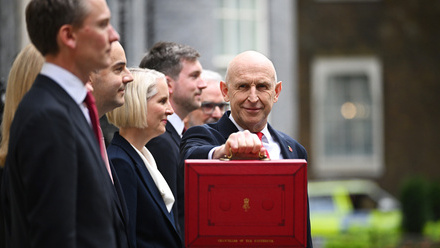
Michael Moore’s Outlook: Autumn Budget
Nothing to see here. (Perhaps not the ideal opening line for a columnist to use, but bear with me.)
The phrase originated as a shout by police seeking to move bystanders on from the scenes of an accident or crime. As a colloquial expression it is regularly subverted to describe attempts to distract onlookers from seeing something awkward or unhelpful. In politics it is a pretty common tactic at difficult moments.
But in this case, I use it (almost) literally to describe the reaction to the government’s Budget at the end of October. It was quite possibly the least remarkable fiscal event of recent political times in the UK. And hurray for that.
Having fretted about where the Prime Minister and Chancellor might land as they mapped out their political choices from here to the election, (most) of the tensions experienced by business in advance eased as the country’s leaders opted for (relatively) safe ground.
As I rehearsed last month, there was a genuine debate about which version of the Burnham-Healey world view would shape the key decisions.
Famously, there had been high profile calls by Mr Burnham before he was Prime Minister for the UK to abandon ’40 years of neoliberalism’ and to stop ‘being in hock to the bond markets’.
The comments always needed their full context to be understood, but let’s just say they created a vibe which observers feared might have influenced the direction of the first Budget of the re-shaped government.
On the other hand, and commendably in my view, there had been consistent messaging from both the Prime Minister and Chancellor about the core principles and priorities that would shape the government’s decision-making: fiscal discipline, economic growth, support for wealth creation.
I would suggest that, of those, only economic growth would be a reasonable bet for a centre left politician, and in truth not always a given. A commitment to fiscal discipline is, to the financial world a necessary (if not guaranteed) commitment, so that is clearly welcome. But the inclusion of ‘wealth creation’ is the most significant, and perhaps unexpected element of the triptych.
Together these principles create a vibe that risks jarring with the critique of markets that had gone before. Aimed at different audiences that might not be a problem, but when everyone is together, it takes a great deal of political skill to blend them successfully.
At the Labour conference last month, the Chancellor addressed party members and business observers in a huge hall in Liverpool. He smuggled the pro-business messages into his speech by wrapping them in a core message about re-industrialising the economy. This risked being over-nostalgic, but it set down a challenge that there needs to be a re-thinking and re-shaping of the economy across the UK. Activists and business figures alike took note.
At the Budget, the Chancellor was in a less amenable setting in the House of Commons. But as he addressed the expectations of his own side, while facing the unforgiving glare of Opposition politicians and the outside world, the triptych prevailed. As a result, the bond markets shrugged their shoulders on the day, and business leaders breathed out more calmly than they might have feared (with the exception perhaps of the banks and gambling firms).
Ahead of time we had set out our stall for private capital. There were specifics requested, of course, such as additional funding for the British Business Bank (£5bn extra capacity - tick), incentives for entrepreneurs (Founders Relief – tick) and an ongoing commitment to driving pension capital into innovative, high growth UK companies (tick).
But our most important request was for stability. After the significant reform of carried interest taxation and the heaping of cost on business through the increase in national insurance taxes in recent Budgets, UK credibility and competitiveness as an investment destination are on the line.
Hence the near celebration that there is ‘nothing to see here’ after the Budget. Stability is an intangible, but vital prize for business. Modest as other measures were, the net position should make the UK a more attractive place to invest, build and grow a business.
Of course, this was one Budget, one moment. The shape of the Prime Minister’s long term plans or how they will be funded did not emerge with any great clarity. A proposed ‘ten year plan’ and a comprehensive spending review next year will do the heavy lifting on that. And those are pretty big asterisks on the verdict.
But the first big, substantive choices have been made and they offer a direction of travel which private capital should be able to follow for now.
Michael Moore
Chief Executive, UK Private Capital
This article was originally published on 29 October 2026 on the Private Equity News website here.