Scaling the UK's Innovation Economy: Insights from UK Private Capital Summit 2026
This year’s Summit brought together investors, policymakers, founders and industry leaders to discuss the forces reshaping the UK’s investment landscape. Against a backdrop of technological change and geopolitical uncertainty, conversations focused on how private capital can support growth, competitiveness, and national resilience.
The tone was set by broadcaster and journalist Amol Rajan, whose keynote explored the consequences of accelerating innovation, from the future of work and social mobility to productivity and public finances. His central thesis was clear: technological advancement has the potential to unlock significant growth, but it also raises important questions about inequality, trust, and the distribution of opportunity.
The role of government in enabling sustained economic growth emerged as a recurring theme throughout the Summit. This was reflected in a discussion led by Leandros Kalisperas, Chief Investment Officer at the British Business Bank (BBB), who outlined the organisation’s evolving approach to supporting the UK’s venture capital ecosystem.
These changes include faster decision-making, more dynamic investment governance, and a greater focus on investment talent. Central to these efforts is addressing one of the UK’s key challenges: helping high-growth companies scale and stay in the UK.
Leandros argued that the UK does not suffer from a shortage of talent or innovation. The challenge lies in capital formation and the availability of growth capital. His comments reinforced the need for a stronger relationship between government and private capital. Among the initiatives highlighted was the BBB’s new £1 billion scale-up fund, as well as the recently announced £150 million Northern Scale-Up Fund.
Prof Sir Ian Chapman gave a speech about UKRI’s unique role in the UK’s innovation ecosystem and its ability to connect researchers, universities, spinouts and industry. Its position at the earliest stages of the innovation pipeline gives UKRI a lot of visibility of new technologies and startups long before they reach GPs and LPs.
He called for greater participation by investors and industry experts in the university spinout ecosystem. He also acknowledged that UKRI could do more to help investors navigate technical due diligence and connect directly with businesses. When pressed on a possible spinout exit tax that has been making headlines, he noted that no decisions have been made and invited views from the industry.
Investors back Defence, Quantum and AI as the UK’s Next Growth Frontier
The VC stage then took a deep dive into the UK’s venture capital ecosystem and what it will take to build the first UK trillion-dollar company. Discussions focused on technology sovereignty, defence innovation, quantum technologies and AI.
Quantexa’s growth story was cited as an example of what is possible. Having initially raised around £50 million and at one stage considered a sale at a valuation of approximately £250 million, the company is now valued at more than £2.5 billion. Panellists highlighted the importance of early domestic support, with the UK Government acting as one of its first customers and HSBC serving as an early strategic investor and anchor client. The lesson was that strong domestic reference customers can play a critical role in helping UK companies scale internationally.
Technology sovereignty featured prominently in the discussion. While speakers agreed the UK has the potential to establish leadership in software and frontier technologies, hardware and semiconductors remain a greater challenge. It was argued that the focus should be on strengthening trusted international partnerships while developing areas of strategic advantage, including quantum technologies and AI-enabled drug discovery.
Quantum was widely seen as one of the UK's strongest opportunities. Speakers pointed to the country’s research base, leading position in quantum company creation and government backing through the national quantum strategy. For investors, the opportunity lies in supporting technologies where the UK can develop deep expertise while maintaining strategic leverage.
Defence and dual-use technologies were another prominent discussion theme. Panellists argued that greater technological sovereignty will require more support for defence-focused startups, stronger procurement pathways and larger seed-stage funding rounds than are typically seen in the UK.On AI, panellists challenged the notion that AI is a zero-sum game, arguing that lower costs and greater accessibility will drive adoption. As capabilities become commoditised, attention is shifting towards businesses that can establish durable positions within specific industries. Investors also continue to see opportunities in infrastructure, including data centres.
The mood at the VC stage was optimistic. Investors predicted that AI will drive a new wave of entrepreneurship by making it faster and cheaper to build companies. From intelligent robotics to AGI, the consensus was that the most transformative applications of AI are still ahead.
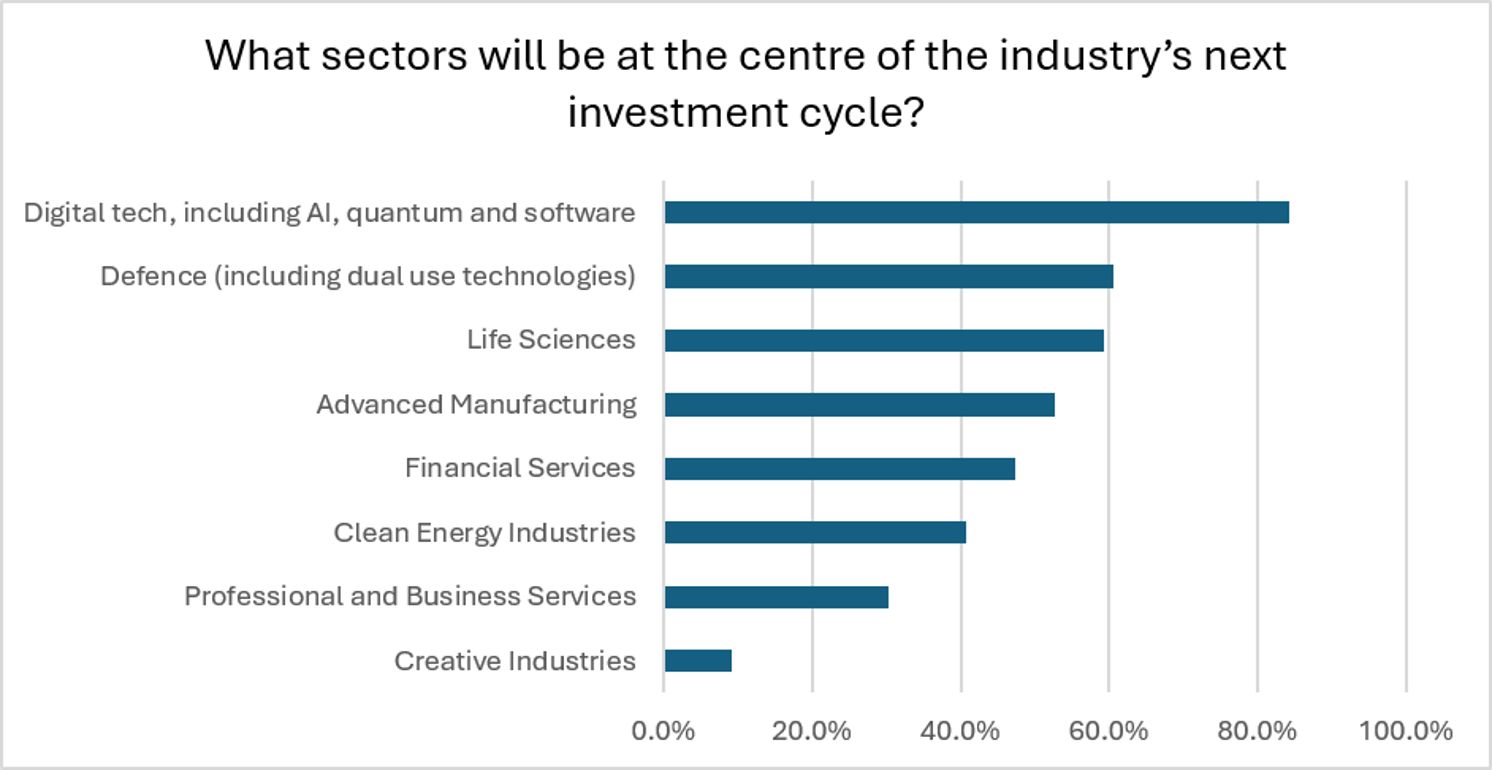
Findings from our latest pulse survey, launched at the conference, reflected strong investor conviction in these areas. When asked which sectors will be at the heart of the next investment cycle, 84% of respondents identified digital technologies, including artificial intelligence, quantum computing and software. Defence and dual-use technologies were highlighted by 61% of investors, while 59% pointed to life sciences businesses as offering some of the strongest investment opportunities in the years ahead.
Across the day, a common thread emerged. Private capital has a critical role to play in supporting the UK’s innovation ecosystem, from supporting defence innovation and driving AI adoption, to addressing the larger questions of growth, competitiveness and productivity. Ensuring that we mobilise private capital effectively will be critical as we look forward to 2027 and beyond.

Authored by Gilma da Gama,
Senior Venture Capital Executive, UK Private Capital